Emotional Engagement in Narrative Medical Visualization: An Electrodermal Activity and Eye-Tracking Study
Beatrice Budich (Department of Simulation and Graphics, Otto von Guericke University), Laura Garrison (University of Bergen), Marc Vaudel (University of Bergen), Jone Trovik (University of Bergen), Florian Heinrich (Otto von Guericke University Magdeburg), Bernhard Preim (University of Magdeburg), Monique Meuschke (University of Magdeburg)

Jump to Discussion
Presentation
- Session
- Can we have a (real) doctor, please?
- Time
- Tuesday, Nov 10, 14:12 – 14:24 (US/Eastern) · session 13:00 – 14:30
- Room
- Hall America north
- Presenting from
- Boston
Links
Sign in to access the Paper PDF.
- Preprint PDF(opens in new tab)
- Supplemental Material(opens in new tab)
Abstract
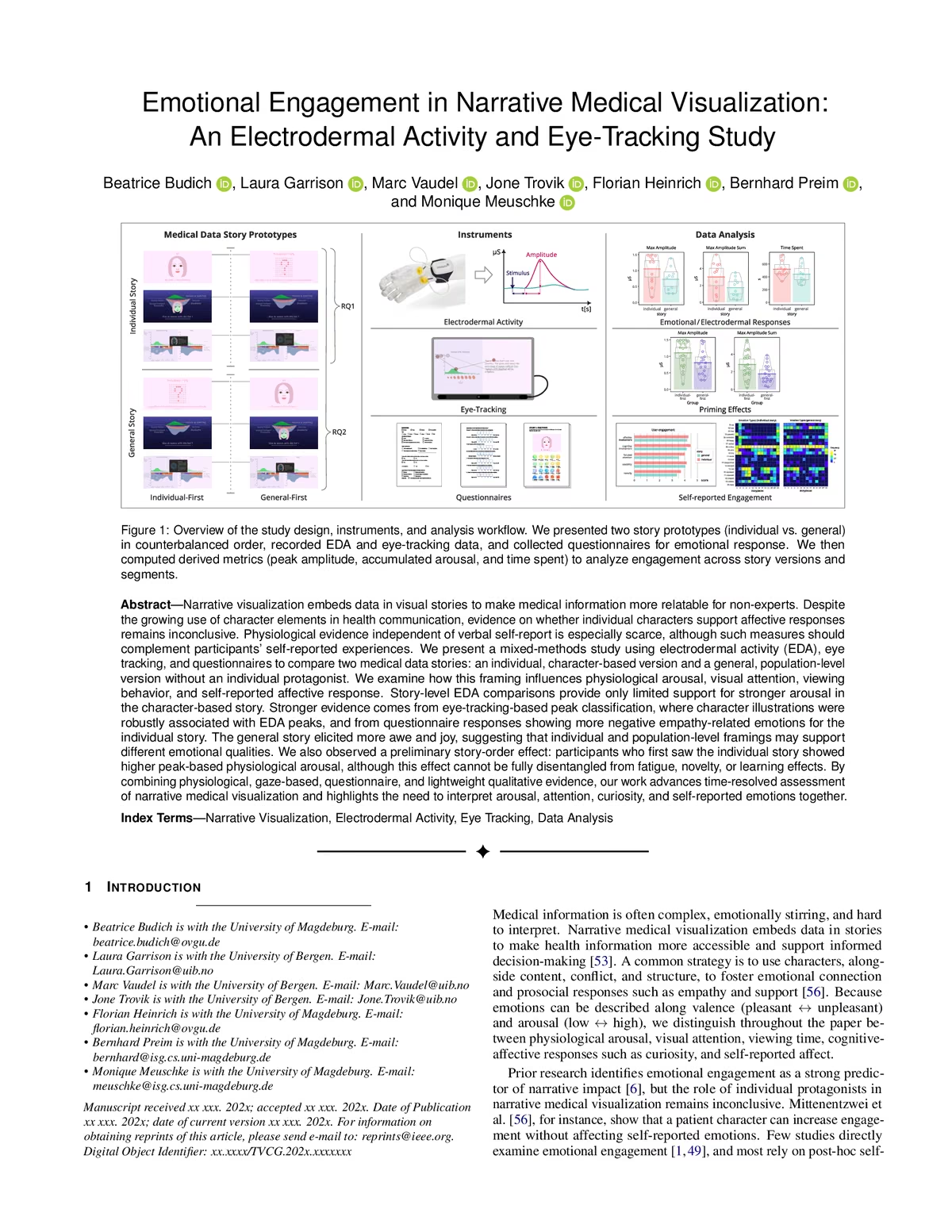
Narrative visualization embeds data in visual stories to make medical information more relatable for non-experts. Despite the growing use of character elements in health communication, evidence on whether individual characters support affective responses remains inconclusive. Physiological evidence independent of verbal self-report is especially scarce, although such measures should complement participants’ self-reported experiences. We present a mixed-methods study using electrodermal activity (EDA), eye tracking, and questionnaires to compare two medical data stories: an individual, character-based version and a general, population-level version without an individual protagonist. We examine how this framing influences physiological arousal, visual attention, viewing behavior, and self-reported affective response. Story-level EDA comparisons provide only limited support for stronger arousal in the character-based story. Stronger evidence comes from eye-tracking-based peak classification, where character illustrations were robustly associated with EDA peaks, and from questionnaire responses showing more negative empathy-related emotions for the individual story. The general story elicited more awe and joy, suggesting that individual and population-level framings may support different emotional qualities. We also observed a preliminary story-order effect: participants who first saw the individual story showed higher peak-based physiological arousal, although this effect cannot be fully disentangled from fatigue, novelty, or learning effects. By combining physiological, gaze-based, questionnaire, and lightweight qualitative evidence, our work advances time-resolved assessment of narrative medical visualization and highlights the need to interpret arousal, attention, curiosity, and self-reported emotions together.
For Practitioners
This paper is relevant for practitioners who design, evaluate, or communicate data-driven stories in sensitive domains. This includes visualization designers, data journalists, health communicators, medical illustrators, UX/HCI practitioners, digital health researchers, and designers of patient-facing educational tools. It may also interest data scientists and public-health researchers who communicate cohort or survey data to non-expert audiences. Practitioners can apply the findings by treating character-based storytelling as a design choice that may shape emotional response, attention, and interpretation, rather than as a universally better approach. The results suggest that individual characters can support empathy-related responses and localized physiological arousal, while population-level framings may evoke broader emotions such as awe or joy. Designers can therefore choose between individual, population-level, or hybrid framings depending on whether their goal is personal connection, public understanding, perceived scale, or balanced reflection. The paper also shows how physiological measures, eye tracking, self-reports, and qualitative feedback can be combined to evaluate not only whether a story is engaging, but when and around which visual-narrative elements responses occur.